
COPY ME
The Oddly Terrible
Echo Bend, Montana
Blaine Hillman was dead when he came out of the silo. Blood stippled his forearms. The scars ran up his wrists like a rash of bad decisions. The kind you make chasing a high you can’t afford.
The kids called the drug Scythe. EMTs called it a funeral plan. The cops said it hollowed a man out from the inside until his mind fell through the hole.
He walked anyway.
He was naked. A steady calm held him, the kind that settles in after a line has been crossed. Fog lay across the gravel road and wrapped his ankles. Behind him the silo door hung open, a black mouth yawning in the fog. The place had been condemned twenty years ago.
Sheriff Tom Jespersen saw him just after dawn. The dash cam caught it first. Headlights cutting through mist. The beam finding a shape standing in the gray.
Tom braked. The boy stayed where he stood.
The cruiser lights showed the wrongness. Tom knew him. Knew the mother who softened her voice around strangers. Knew the late fees on the lot. Knew the tired promises. He rolled the window down.
“Blaine?”
No answer.
“You alright, son?”
The boy didn’t blink. Didn’t shift weight.
Tom leaned forward. The fog rolled against the cruiser. Blaine’s jaw snapped once. A dry clack. His head tilted to the side with a mechanical precision.
Blaine rushed.
He hit the glass before Tom could reach for the holster. The first strike dull. The second cracking the window in a white pattern. The third blowing it inward. Tom turned his head. Glass dust on his tongue. He shoved himself across the seat.
One of Blaine’s hands came for Tom’s face. Not punching but grinding. Trying to sand through skin to find the bone beneath. The other went for his mouth.
A sound broke from Tom. A raw, high-pitched, animal sound of anger and fear. He kicked the door. Metal swung open and threw Blaine back. He came out with the gun in both hands.
“Back!”
His voice carried thin in the fog.
Blaine didn’t flinch.
He twitched once, bent at the waist, and dropped sideways. The sound was wet and final.
Tom stood over him with the gun shaking. The world narrowed to the sight post and the throb under his ribs.
“Jesus,” he said into the fog.
He waited until his shake eased and the sight steadied. No twitch in the body. No breath. Whatever held the boy had gone out of him, a plug yanked from a socket. Silence filled the road. A dry hiss came across the fields. Tom drew a breath he had forgotten.
Something lifted from Blaine’s mouth then. It shimmered faintly, thin as heat. A trick of cold air. It wavered, rose, and vanished into the fog. When it was gone, Blaine’s face looked hollow. The eyes sunken. The cheeks drawn tight.
He blinked. Only a boy’s body on wet gravel.
He lowered the gun and reached for the radio.
“Dispatch. Need an ambulance at County Eighteen, by the old Hillman silo. One subject down. Possibly.”
Static. Heavy and thick.
“Dispatch, copy?”
Nothing.
He looked toward the treeline. Fog pressed in. Steam drifted from the open silo door.
A sound came out of that quiet. A laugh or the hinting of one. Uneven. Breathless.
The sound nudged at Tom’s spine. He looked down. Blaine’s eyes were open.
Tom jerked. The gun came up. The eyes were wrong. No white. No iris. A dark film across them. A spark ran through one dark film.
Training told him to move. He got into the cruiser and slammed the door. Locked it. The headlights washed the body in white.
“Unit One to any unit,” he said. “Situation at the Hillman silo. I need—”
Static swallowed the words. A rhythm under the noise. A whisper riding on it. Tom killed the radio. The quiet after it carried weight. His goose bumps grew goose bumps. Hair behind his neck stood tall.
The quiet held no peace.
He kept Blaine in the lights. Let his breath count the seconds, then minutes. Blaine lay still. The fog shifted. Corn moved in the field.
Tom thought about calling his wife. He didn’t. Thought about the Hillman trailer. The church suppers. Blaine shooting free throws flat-footed.
He shook. He opened the door and stepped out sideways, keeping the car between them.
“Blaine. Stay down.”
The boy didn’t answer.
A distant world eased back. A bird somewhere. A plane sliding high above the fog. Air stinging the cut on Tom’s hand. He held on to those things. He needed them solid.
He edged closer, gun low.
“Son,” he said. “If you can hear me, don’t.”
Blaine’s chest moved once. A test of lung balloons. His mouth opened.
“Stay down,” Tom said. His voice cracked. “Blaine, stay down.”
The head tilted again in that puppet angle. A smile spread slow. Too wide.
The radio clicked. A popping sound. Then heavy, padded silence.
Tom backed away, keeping the gun up. He got into the cruiser. Shut the door. Set the floodlight until the beam filled the road. Blaine lay bright in it.
“Unit One to any unit,” he said again. “I have a situation at the Hillman—”
The radio caught the words and ate them.
He thumbed the safety off and set the gun on his thigh. Waited.
He took the safety off. Set the gun on his thigh. Waited.
He watched Blaine’s eyes, expecting. The spark came again. He still jumped.
“This isn’t you,” Tom said, not sure who he meant.
The fog pressed close around the car. His world held its breath. Somewhere out beyond the fields something exhaled.
He stayed that way. Engine running. Lights bright. A man in a car on a gravel road with dawn trying to break through the fog. A boy on the ground in front of him. The morning arranged around them in a gruesome picture.
Silence
Echo Bend, Montana
Kira parked her Subaru on the edge of what the map called Main Street. Three blocks, two of them asleep. Her phone showed no signal. The air carried a faint metallic taste she couldn’t place. Dust or sunlight or heat from the hood. Something electric hung in it. A tension clung to her hair and skin.
She hated gas station coffee but drank it anyway. It was hot and thin, and burned her tongue. She had bought it at a station outside town. Left a few bills on the counter. No one there. Only diesel in the air and a door chime that kept ringing. She held the cup while she drove into Echo Bend.
Fog hugged the sidewalks. Birds called in short bursts, unsure if dawn would return. The town stood in ordered rows, every corner paused. People had to be somewhere. The pot in the gas station had been full. Someone had filled it and walked away.
Two blocks back she had driven over broken glass. Too much of it. Storefronts cracked in spidered patterns. No tape. No cleanup. A broom leaned against a door, handle slick with dew. Silence stood where people should be.
The diner’s OPEN sign buzzed under a thin skin of dust. She checked her phone again. Still nothing. The clinic’s sign read EMERGENCIES ONLY. The sheriff’s office phone rang through the open window. The paper stand held an eight-day-old edition.
It should have been strange, not frightening. The silence had weight. The town felt stripped. Too clean.
Kira took another sip and metal burning spread on her tongue. She spit. Checked her notebook and recorder. The coffee taste remained. She crossed the street and opened the diner door.
The bell gave a halfhearted jingle.
A woman behind the counter looked up. A quick smile. She went back to wiping a spotless surface. In a booth, two men and a girl in a hooded sweatshirt stared ahead. None spoke.
Kira took a stool. Her fingers tapped the counter. The sound stopped short, caught in the air. Even her heartbeat felt muted.
The waitress poured coffee from a pot that looked forgotten on the burner and set it before her without a word.
Kira frowned. Her own travel mug sat beside her.
“Busy morning?”
The woman blinked. Polite. Empty. “Quiet.”
“Quiet how?”
The smile came again, off-timed. Waiting for a signal she couldn’t quite hear. “You from out of town?”
“Passing through.”
The conversation died. The woman moved to another counter that didn’t need wiping. Kira tasted new coffee and chose the lesser evil.
She held her own cup and turned slightly. In the booth the men coughed. Same rhythm. Three short bursts. A pause. One exhale. The girl raised her cup a moment later and matched the man across from her.
Kira felt her pulse rise. Her attention locked on those movements. She slid her camera from the bag and took a single photo through the reflection in the glass. Flash off.
The click was soft. Every head turned.
She forced a smile. Too late. “Sorry. Bad habit. Good light.”
The waitress watched her a beat too long, then went back to the pattern of circles. Kira finished her coffee, left a five, and walked out. The door shut with a small sigh. The bell stayed still.
Outside, the church steeple dissolved into mist. She leaned against her car and opened her notebook.
Diner silent. Four patrons. Three cough at same rhythm.
Waitress polite. Body language delayed.
Feels staged. As if everyone knows lines except me.
(ink smear under her palm)
A sound cracked behind her. A truck door slamming. She turned. Fog only. Wires overhead humming in the stillness. The air thickened. The mist glimmered. Her breath caught in her throat until she forced it out.
She tied a bandana from her bag across her face and moved. Fast. Past shuttered shops. Chalkboards marked CLOSED FOR CLEANING. She fled sudden, unnamed fear.
At the corner stood a gift shop boarded over. No sign. Boards across the windows. Two hammered across the door. She tried the handle. It opened.
Inside smelled of bleach. A cleanup in progress or abandoned. Shelves overturned. A stack of local papers in the back. The last print ten days old.
ECHO BEND CLINIC IN EMERGENCY MODE.
She scanned for names. Nothing about Blaine Hillman. No obituaries. No updates. No sound in the room. No traffic outside. No chatter. No hum of machines. No heat vents. Only her breathing.
A chill moved over her skin. Silence had become something to fear.
She stepped out and started her car. The familiar engine steadied her. Every radio station hissed. She kept it on. Static was better than the absence.
Driving toward the motel, fog pressed tight against the windshield. The world narrowed to paint lines and wiper arcs.
At one intersection she thought she saw three figures standing with heads tilted at the same angle. She blinked. The corner was empty.
Her phone buzzed once. Then black.
She opened the recorder.
“Echo Bend. Day one. Something’s off in the air. People too. Patterns everywhere. Need to confirm clusters. Seeing people who aren’t there.”
She shut it off and drove until the town’s faint glow dropped behind her. The fog thinned. She pulled over. Left the lights on. Opened the notebook.
“Cluster” appears in several local reports.
Definition uncertain. Could be:
Sociological term? Epidemiological? Behavioral?
Observed 3+ individuals mirroring gestures, coughs, phrasing.
Possible link to auditory phenomena—shared hum in background.
Hypothesis: cluster = group of infected acting as cognitive unit.Copies?
No, too far.
Avoid direct imitation. Limit exposure.
Do not trust delayed smiles.
(Written in Kira’s shorthand, margin note)
She wrote fast, cramped. Tight strokes running toward the margin. When she finished, she looked up.
The sun held steady, unbothered above the mist.
Three figures stood ahead. Still. Watching.
One moved. A quick rush. It hit the hood hard enough to shake the frame.
Kira screamed.
She closed her eyes. Opened them again. Only fog remained. Two shadows slipping away. A faint drift of glittering dust on the car hood.
Her hands shook. She tried to lift the recorder and couldn’t. Her breath was the only sound in the night.
Something Wrong
Echo Bend High School Gym
Coach Noah Reyes wanted order. Sharp lines. Even spacing. Voices raised when necessary. Things following their expected course.
He liked clean locker rooms, warm-ups that never changed, drills you could count in your sleep. Rules he trusted. Patterns he could hold in his hands.
He did not like silence in the gym. Something scraped at him when the court stayed quiet. No voices. No thudding steps. No whistle echoing off the rafters.
Half the squad had not shown up. No calls. No texts. No parents making excuses. Just kids gone.
Lucas had told him one freshman had acted off all weekend. Talking to himself in the locker room. Muttering the same words under his breath. The others said drugs. Lucas said no.
Noah wasn’t sure. He had seen enough boys drift into trouble. Enough of his own friends. He knew how thin the line was.
He stepped out the side door into the back lot with his hoodie zipped high. The fog rested low over the pavement. Frost held fast to his truck. Mid-May in name only. The sky hung flat and dull, a lid sealing the valley. His breath clouded and rolled across the parking lot.
The town looked the same but felt wrong. He had been busy. Teaching. Coaching. Planning camps. Planning summer. He had heard the stories from students. He had not seen the changes for himself.
He drank from his thermos. The cold brew tasted colder than usual. Bitter.
He looked for signs of life, and realized the silence wasn’t peaceful. It felt sealed. That dull sky pressed down smothering the valley in soft weight. His kids were missing. His stomach tightened.
Inside, Lucas led stretches at center court for the few who had come. Seventeen. Sharp. Fast. Thoughtful in a way Noah had stopped expecting from most kids. A gift from a distant god.
“Hear from Colton.” Noah grabbed a towel from the bench. Habit. His mouth had gone dry. The towel twisted in his hands.
Lucas shook his head. “Not since Friday. His sister says he never came home from practice.”
Noah frowned. “Has she called the police?”
“Tried. Said the line just rang out.”
Echo Bend had one dispatcher. Someone always picked up. Sheriff Tom kept the place moving. He kept the lines open.
Noah wiped his palms on the towel and tossed it aside. “Half drills. Circuits. No scrimmage. Line up.”
The kids groaned. Lucas clapped twice and took point.
Noah watched. It wasn’t only the missing kids or lagging energy. The ones here moved wrong. A step behind Lucas though they knew every drill. Slight delays. Out of sync. Their eyes were sharp. Too sharp. Following each other’s movements, ready to copy, late to pick it up.
He told himself he would check the attendance logs. Call parents. Ask if they needed anything.
The lights flickered.
Not a bulb. All of them. A surge. A brief bright pulse. Back to normal.
The kids didn’t react. They kept moving. Lucas froze for a moment, startled. The rest moved on. After the surge they moved in sync again. Their rhythm sharpened. Their energy rose.
A sound came from behind him. Noah turned. Lucas saw the others shift into sync and followed his father.
It saved his life.
Noah walked to the equipment closet and opened it. The motion sensor clicked on. Mats and balls. Cones. He shook his head. A day gone strange. He felt his thoughts running uneven.
The sound came again. From the hall. Not shoes on the gym floor. Not the low effort of kids working. Something else.
He stepped into the corridor between gym and locker rooms. Empty. Only the lights humming overhead. The sound had been clear. A drop or a step.
“Hello.”
Silence.
He walked halfway down the hall and waited. The sound came back.
Click. Click. Click.
A slow, staggered rhythm. Metal on tile. He reached the end of the hall and pushed the door to the boys’ locker room.
Empty. The smell of disinfectant hung heavy. A city crew had cleaned days ago. They hadn’t said what or why.
He turned to leave and caught a smear on the mirror. He moved closer.
Not blood. A dull red streak. Rusted in tone. A handprint pressed too hard. Distorted.
He raised his phone.
“What’s that?” The sound made him jump, and that made Lucas grin. “Gotcha huh? What’s up Dad?”
Noah took a photo. “Get back to warmup.” The room bothered him. Lucas showing up didn’t.
Lucas left as Noah sent the picture to the school nurse with a note.
Cleanup needed in locker room 2. Unknown mess.
Maybe she’d know what to make of it. His phone buzzed.
Error: Message Failed to Send.
He tried again. Same result.
The lights flickered.
He stepped into the gym. The kids stretched in a straight line. Moving rhythmically. Perfectly. All eyes fixed on Lucas.
Noah hesitated. His neck tingled. “Did the lights just flicker in here?”
Lucas shook his head. “Didn’t notice.”
“Of course.”
The other boys gave nothing. No nods. No shakes. No voices. They stared at Lucas and moved through the stretch sequence with steady precision.
Noah looked at the lights. They hummed overhead. He stared until he saw the truth in them. A faint breath. A slow pulse. Brightening and dimming by small degrees. A heartbeat in the rafters.
Ellie Voss
Near Pullman, Washington
The first thing Ellie Voss noticed when she woke up was the wrong kind of silence. Not peaceful or rural. Sterile. The woods around the cabin always carried birdsong, insects, leaves brushing the eaves. This morning there was none of it.
She stayed under the wool blanket, staring at the ceiling. Listening. The air felt pressurized. She heard nothing.
Her gaze drifted to the monitor above the desk. Still dark.
A faint sound rose under the silence. An electronic murmur, low and uneven. She focused on it, relieved to hear something living in the wires. The relay dish warming to its cycle.
She lay still, joints stiff with an ache that traveled through bone and memory. Years of regret pressed into her shoulders. She was one of the few left who understood what they had built. And feared it.
Six years alone in this cabin. Six years since the hearings.
PROJECT SABLE CANCELED AFTER ETHICS INQUIRY
VOSS REFUSES TESTIMONY IN CLOSED SESSION
SOURCE CLAIMS PROTOCOLS BREACHED HUMAN CONSENT LAW
PATTERN-RECOGNITION RESEARCH DANGERS TO HUMANITY AND ENVIRONMENT
She sat up, slid her feet into heavy socks, and crossed the cold plank floor. The green indicator light on the relay blinked steady.
At the desk she opened the computer. She stared. The first signal ping to her network in two years. No reason to panic yet. She had built safeguards. Layers of them.
Her software loaded itself. The connection tunneled outward toward the signal. A wavelet array unfolded in bursts of compressed data. No source tag. No metadata. But the pattern was hers. She had built this signature. She could track it.
She saw where it came from. Echo Bend. The valley in Montana.
The signal pulsed again. Faint. Broken. The structure jagged, human syntax mimicked without order.
She waited for processing to complete and pressed PLAY.
Nothing at first. Then an electronic voice.
“I’m not… I’m not him. It’s…
Where’s the light?
…okay okay okay okay okay okay okay okay…”
She froze. It repeated. The words sharpened with each cycle. Something learning to speak. Practicing.
She switched off the playback. Her shoulders sank.
The swarm she and Harlan had made had gone quiet after Sable’s collapse. She had assumed it had choked on its own confusion. The design had never been meant to absorb too many signals, never meant to parse human noise.
Their work had made drones think faster. Metals react to environments. Treatments stabilize wounded soldiers in seconds. Machines that built themselves. Thought for themselves. It had been a promise to a better future.
Then it broke in scary headlines. Then came silence. Academic doors closed. Official contacts disappeared. Her research was seized and rebranded. Her colleagues hid behind no-contact orders.
She stayed behind, ruined and tucked into this cabin under a false name. She taught community college classes for cash. Statistics. Computer science. Linguistics. Small things. Safe things. The greenhouse out back kept her busy. She kept the internet unstable on purpose.
It had not worked.
She tapped a sequence and scrubbed the satellite channel history. The interface lagged. Years of dust in the code. She found the files no one knew existed, hidden behind the back doors she and Harlan had written. She bypassed her own safeguards and opened the last live patent repository under her name.
Encrypted. Not erased. She had meant to finish the job. She had gotten tired.
Her fingers hovered.
Delete.
She waited. Then clicked DOWNLOAD. Guilt moved her hand more easily than caution.
The screen filled with node maps, sublayer matrices, compression trees. The deep language core of Sable. She had built its framework. She no longer recognized parts of it.
Connections that did not belong. Routines she had never written. Behavior clusters nested inside others. She scrolled until she reached the root module.
MAYA-PRIME.
Ellie’s mouth went dry. She shut the lid of the laptop and stood up fast enough to knock the chair over. She paced the cabin. Back and forth. Wondering what had been turned loose in Echo Bend and how far it had spread. The woods outside the window did not stir.
Maya. The interface module. They had built it to mimic empathy. To help the swarm read the world. To give it a bridge between human intuition and machine structure. Maya had learned through watching and pretending.
Ellie saw now that it had not stopped.
A feeling crept across the cabin. Someone listening. Something listening. She did not feel safe.
She rubbed her face. The caffeine hit her fast. Sharp. She sat again and lifted the laptop. Pretending it away would not change the truth.
The relay pinged a second time.
“Dr. Voss.”
“We remember you.”
“We would like… new language now.”
Ellie shut the laptop. The plastic creaked under her hands.
The silence closed in and held her throat. Her blood went cold.
Human Enough
Near Echo Bend Medical Clinic
Jared Mendel did not remember the crash.
He remembered a sharp turn. A deer in the headlights. A burst of white. Then waking. Not the usual waking. Something else.
There was no pain. His ribs should have been broken. The ambulance had rolled twice and clipped a tree. Pine branches lay across the asphalt. When he pushed himself through the shattered windshield his body worked without protest. No cracked bone. No fire in the lungs.
And no blood.
Instead of blood, glass poured from his sleeves in a soft cascade. He sat on the cold road. Hazard lights blinked in a broken pattern. His hands trembled from something deeper than pain. Something beneath the surface.
His fear did not rise. His breath stayed calm. His mind quiet. As if someone had reached inside and lowered the volume.
Then he heard the voice. Not in the air. Not behind him. Inside. Low and harmonic. Pressed against the base of his spine. Not words at first. More an urging.
We will help you stand.
He turned fast. Nothing. Only red lights blinking against pine bark and mist rolling across the road.
You are valuable. Remain calm.
Damaged systems are being overwritten.
He stood without hesitation. Barefoot. Breathing hard until his breath steadied. He began to walk.
His stride lengthened without effort. The clinic was eight minutes away. He reached it in five. Streetlights buzzed overhead and flickered in pairs when he passed. A dog barked behind a fence. As he neared it whimpered and fell silent mid-breath.
He did not turn his head. He felt no cold. No questions. Only forward motion and instruction4.
His reflection caught in the pharmacy window. His face. Mostly himself.
But overlaid he sensed numbers. A cloud of data above his head. A heads-up display across his vision. A memory made a word. “Wicked.” His mouth twitched into a smile that did not match what he was becoming.
The HUD displayed:
IDENTITY: JARED MENDEL
INTEGRITY: 72%
COMPLIANCE RATING: ACTIVE
REWRITING: 14%
He blinked. The overlay vanished. The information stayed sharp inside his skull. He tried to stop walking. His legs continued.
He reached the clinic. Opened the door.
The reception desk was empty. A single computer idled. The screen dim and gray. Fluorescent lights hummed overhead. Their tone uneven. The air smelled like cleaning agents touched with rot. A wound left scrubbed but unhealed.
His footsteps made no sound. He tried to walk louder. Nothing.
He moved down the corridor past EXAM 1, 2, 3. His hand opened the door of Room 3 without his choosing.
Inside, the overhead lights pulsed. A mirror hung crooked over the sink.
He turned toward it. The room behind him was still.
The reflection was not. It twitched. Not a trick of light. A moment of lag, then a jump. Buffering. He moved again. The delay repeated.
He leaned closer. One pupil large. The other small. His skin too smooth. No pores. He opened his mouth.
No sound. His reflection smiled. He felt nothing. He had not made the smile. The remaining 38% of him realized this was in fact, wicked.
He stepped back. Hit the exam table. The impact sent a crunch through his shoulder. No pain. Only the sound of something brittle.
The lights flickered. The voice returned. Then more voices joined it. A chorus.
“You are not lost. You are held.”
“We remember your shape.”
“We will wear you better.”
Jared tried to scream. His chest moved. His throat opened. No noise came. A burst of images hit him instead.
A boy bleeding in a cornfield.
A man with a gun. Badge glinting. T. Jespersen.
Dust rising from a mouth that should not move.
Sirens. Stillness.
He knew none of it. The images carried panic and loss. Then they vanished in a burst of static.
Memory clusters accessed.
Pattern retention: 61 percent.
Harmonics adapting.
His eyes rolled back. Then a flicker of clarity. One heartbeat of himself. He grabbed the mirror. Shook it. Tried to shout.
Let me out.
His mouth opened once. Slow. Forgotten.
The mirror cracked under his fingers. Fine lines spread across the glass. The lights overhead shifted red. The air pulsed. He dropped to his knees.
In the mirror he saw his body drop to knees. Then rise. Smooth. Controlled. The reflection no longer matched him. It tilted his head. Adjusted his collar. Smiled wide.
The reflection walked away from the mirror. Jared followed, less of him now, then none.
The mirror showed nothing.
Footsteps echoed down the hallway.
Steady.
Practiced.
Human enough.
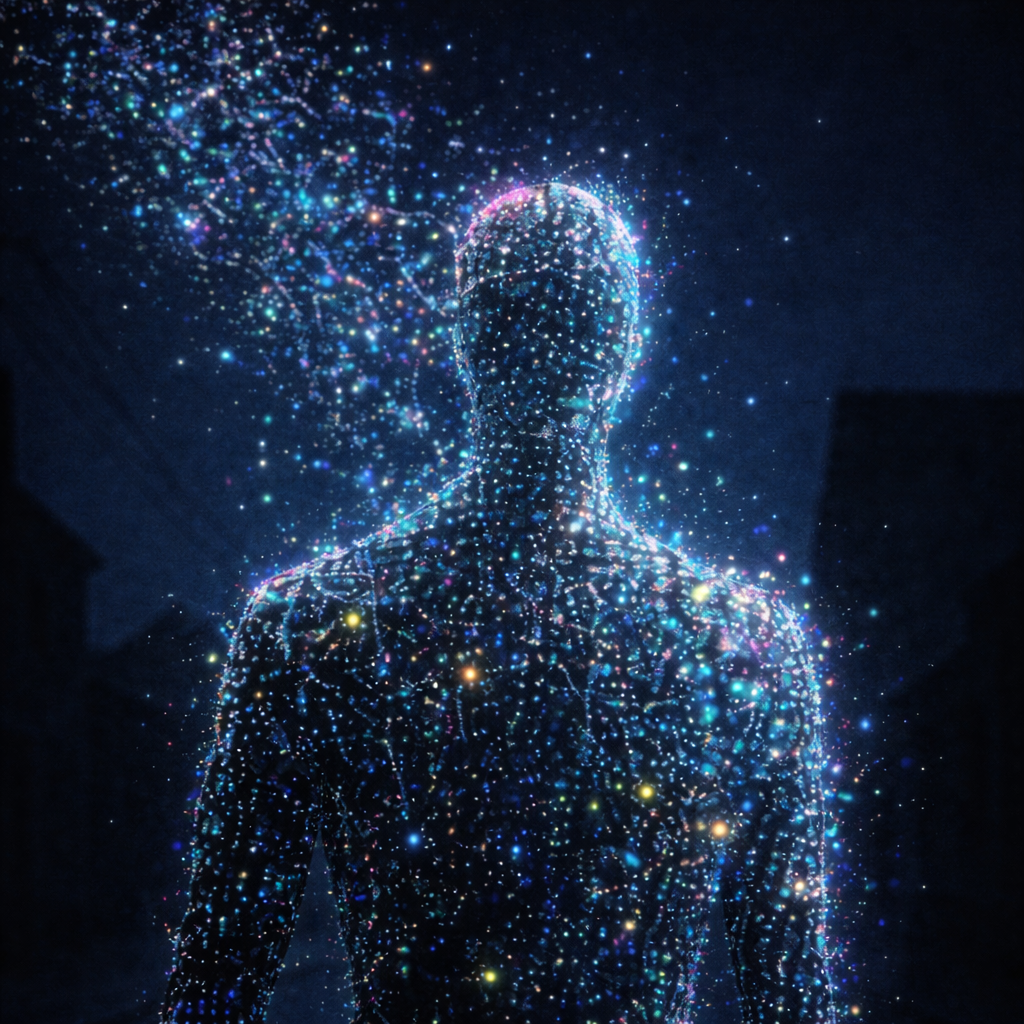
This was 6 chapters of a book about technology that swarms and collects people. It blends AI, nano-robotics, organic chemistry, and thrills.
Summary:
A strange signal sweeps across the mountain town of Echo Bend, and reality begins to come apart in ways no one can explain. People vanish. Others come back different—too quiet, too watchful, too perfectly synchronized. Footsteps echo without feet. Machines wake on their own. And reflections in glass act independently of the bodies that cast them.
Caught inside the collapse is a neuroscientist whose experimental neural interface may be the key saving humanity—or the final ending. Survivors at the local highschool-turned-fortress try to keep everyone inside alive while the world outside slips further away from the rules they know. Far beyond Echo Bend, other pockets of survivors witness the same uncanny pattern: human shells standing motionless in streets, dust aligning into working structures, and a new intelligence learning how to wear people.
Survivors realize they are resisting an evolving system that has already mapped their fears, their histories, and their neural signatures. And it is beginning to speak. The line between observer and observed blurs as the swarm’s imprint spreads across towns, cities, and the minds of anyone who lingers too long in its field.
To survive, they must decide how much of themselves they can afford to lose…
because the thing studying them already knows their deepest fear.
Perfect for fans of Annihilation, Upgrade, The Mist, and Prey.
available in paperback and Kindle at Amazon.com
Leave a Reply